American Mahjong · 6 hands
Consecutive Run Hands in American Mahjong: How They Work, Scoring and Odds
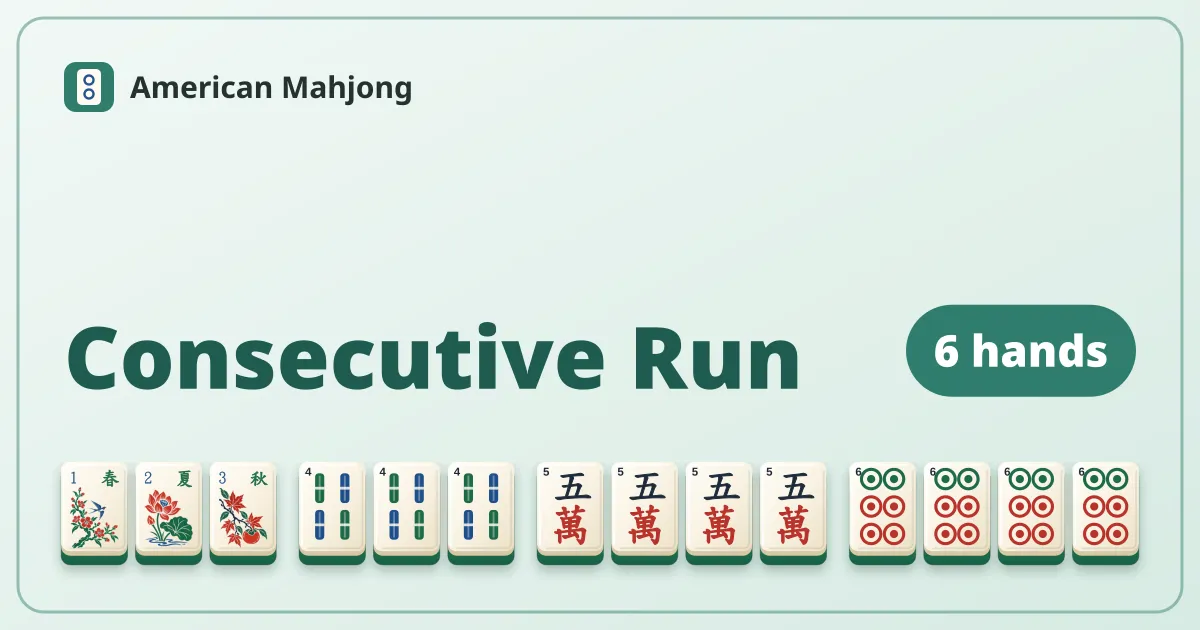
In American mahjong, a Consecutive Run hand (often just "consec" or "run") uses numbers in a row — 1-2-3, 4-5-6-7 and so on — and you choose where the run starts. Like Like Numbers, it fits almost any deal, which makes it one of the most played categories. Our House Card has six run hands, worth 25 to 40 points.
| Card value | 25 |
|---|---|
| No jokers (doubles the value) | ×2 = 50 |
| Won on a discard: discarder pays double | 100 + 50 + 50 = 200 |
| Self-drawn: everyone pays double | 100 × 3 = 300 |
On this page
What counts as a Consecutive Run hand
- The card prints the run starting at 1 with the note "any consecutive numbers"; slide it to any start that stays within 1 to 9 (see reading the card)
- The order of the numbers is fixed: the first number on the line is the lowest, and each group after it is one higher
- Colors decide the suits: some lines stay in one suit, others spread the run across two or three
Xhands may expose groups by calling discards; theCline stays concealed- Jokers can fill any group of three or more, never a single or a pair
Every Consecutive Run hand on our card
- Four numbers in one suit — two kongs and two pungs, such as 3-3-3-3 4-4-4-4 5-5-5 6-6-6.
- Flowers and three numbers in three suits — a pung of flowers and one group per suit.
- Pair, two kongs and a matching dragon — all in one suit, with the dragon kong of that suit.
- Flowers and three numbers in one suit — a kong of flowers, two pungs and a kong.
- Five in a row, then the ends — five singles in one suit, a kong of the lowest number and a pung of the highest in the other two.
- Four in a row in all three suits — concealed, all singles, worth the most.
How jokers work in Consecutive Run hands
Four of the six lines are mostly pungs and kongs, so jokers go almost anywhere:
| Card value | 25 |
|---|---|
| No jokers (doubles the value) | Uses jokers — no bonus |
| Won on a discard: discarder pays double | 50 + 25 + 25 = 100 |
| Self-drawn: everyone pays double | 50 × 3 = 150 |
Singles are a different story. The five in a row on the fifth line and every tile of the concealed line must be real:
| Card value | 30 |
|---|---|
| No jokers (doubles the value) | Uses jokers — no bonus |
| Won on a discard: discarder pays double | 60 + 30 + 30 = 120 |
| Self-drawn: everyone pays double | 60 × 3 = 180 |
How Consecutive Run hands are scored
Each hand pays its card value, and a hand built with no jokers at all is worth double. On a discard, the player who discarded pays twice the value and the other two pay once; on a self-drawn win, all three pay twice. The tables are worked out by the game's own scoring code.
| Card value | 40 |
|---|---|
| No jokers (doubles the value) | ×2 = 80 |
| Won on a discard: discarder pays double | 160 + 80 + 80 = 320 |
| Self-drawn: everyone pays double | 160 × 3 = 480 |
Consecutive Run odds
How close your deal is
A run can start anywhere and slide between suits, so almost every deal has one within reach. Before the Charleston, a 13-tile deal is within 6 tiles of the nearest run hand 14% of the time and within 8 tiles 80% — far more than any fixed-number category; after the Charleston, within 6 tiles rises to 47%.
| Consecutive Run | At the deal | After the Charleston |
|---|---|---|
| 5 or fewer away | 2.2% | 28% |
| 6 or fewer away | 14% | 47% |
| 7 or fewer away | 43% | 66% |
| 8 or fewer away | 80% | 82% |
| 9 or fewer away | 98% | 93% |
Source: 20,000 random 13-tile deals (jokers and flowers included), before the Charleston.
Source: 1,500 games of computer-vs-computer play on this site (normal level, Charleston included). Each computer has its own slight taste for categories.
How often Consecutive Run wins
When the computers play normally, run hands were 31% of all wins, collecting 160 points on average. 40% of those wins were self-drawn and 12% used no jokers — the highest no-joker share of any category; the concealed line, for one, can never use jokers.
| Category | Share of wins |
|---|---|
| Like Numbers | 40% |
| Consecutive Run | 31% |
| Winds & Dragons | 9.5% |
| 2468 | 6.5% |
| 369 | 4.0% |
| 2026 | 3.4% |
| 13579 | 3.1% |
| Addition | 0.72% |
| Quints | 0.57% |
| Singles & Pairs | 0.57% |
Source: 1,500 games of computer-vs-computer play on this site (normal level, Charleston included). Each computer has its own slight taste for categories.
Is it worth forcing a Consecutive Run?
We had the player whose deal was closest to a run play nothing but run hands — Charleston, discards, calls and wins — while the other three played normally, and compared the result with the same kind of deal played normally.
| At the deal | Hands | Made it | Someone else won | Wall game | Avg. result forcing it | Avg. result playing normally |
|---|---|---|---|---|---|---|
| 6 or fewer away | 744 | 22% | 70% | 8.2% | −1 | +7 |
| 7 | 657 | 15% | 76% | 8.4% | −13 | +2 |
| 8 | 99 | 11% | 84% | 5.1% | −24 | −3 |
Source: 1,500 games of computer play on this site. In each, the player whose deal was closest to Consecutive Run played only Consecutive Run hands; the other three played normally. Money is the card value as paid in the game.
Runs hold up almost as well as Like Numbers, but forcing a run still did not beat normal play.
- The player closest to a run is almost always close: most chasers started within 7 tiles. From within 6 tiles, forcing a run worked 22% of the time for an average of −1; the same kind of deal played normally averaged +7.
- From within 7 tiles, it worked 19% of the time (−6 against +4), with someone else winning first 73% of the time.
- The gap is small because normal play already ends up in a run so often — runs were 31% of all wins. Committing early mostly gives up the switch to Like Numbers when your tiles pair up instead.
Tips for Consecutive Run hands
- Let the run float. Keep any three or four neighboring numbers through the first Charleston and decide where it starts later.
- Know which lines are one suit. Three lines stay in one color; if your neighbors are spread across suits, aim for the lines that cross suits.
- The concealed line rewards a clean deal. Twelve real singles is a lot, but a deal with 3-4-5 in all three suits is already halfway there.
- Watch the ends. A kong of 1s or 9s is the same tile everyone else may be holding for 13579 or Like Numbers; edge numbers run out fast.
When to switch: if your neighbors keep pairing up, try the consecutive pairs line in Singles & Pairs; if your kongs all share one number instead, move to Like Numbers. Play a few hands of free American mahjong online — the helper shows your closest hands as you go.
Other mahjong styles
The first run line — four consecutive numbers in one suit, all pungs and kongs — is close to two classic Chinese and Japanese ideas: a one-suit hand (qing yi se in Hong Kong mahjong, chinitsu in Japanese riichi) and an all-pungs hand (dui dui hu, toitoi).
FAQ
What is a consecutive run in mahjong?
A consecutive run hand is a line on the American mahjong card that uses numbers in a row, such as 3-4-5-6. You choose the starting number.
Can a run start at any number?
Yes, as long as the whole run stays between 1 and 9. A four-number run can start at 1 to 6, a five-number run at 1 to 5.
Can you use jokers in a run hand?
Yes, in pungs, kongs and flower groups of three or more. Singles — including the five in a row and the whole concealed line — must be real tiles.
How many points is a run hand worth?
On our House Card, run hands are worth 25 to 40 points, doubled if you use no jokers.
Is this the official NMJL card?
No. The National Mah Jongg League publishes a new copyrighted card every year. This site uses its own original card with the same kinds of categories, so the exact lines differ.
Related categories
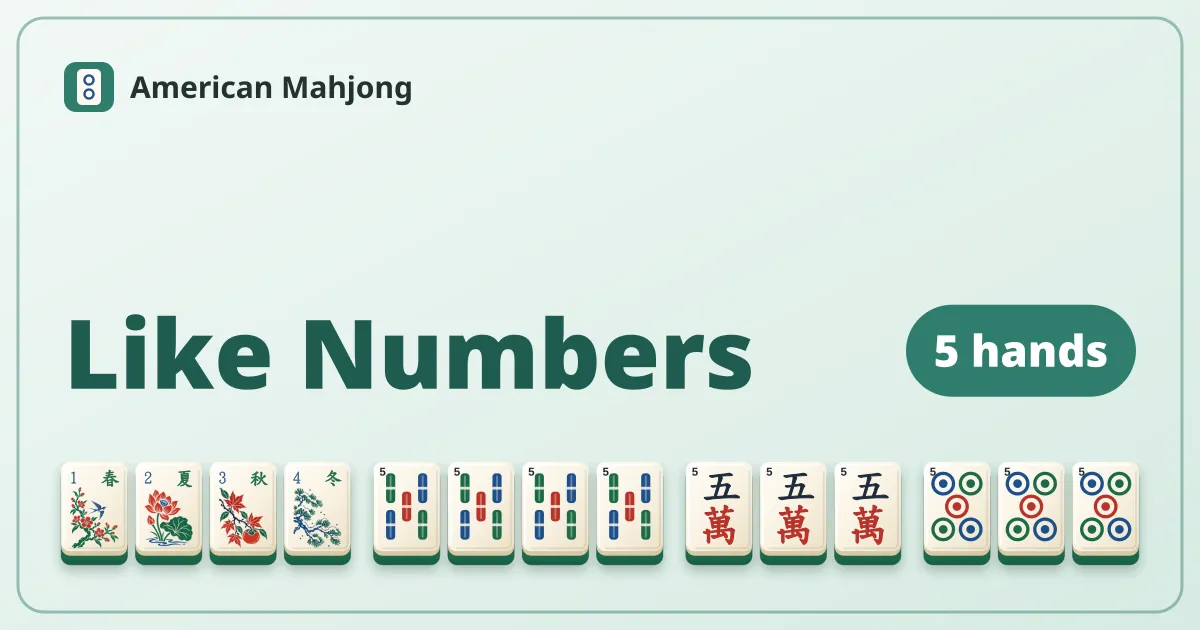 Like Numbers 5 hands
One number, any number, across all three suits — every hand on our card, joker rules, scoring and odds.
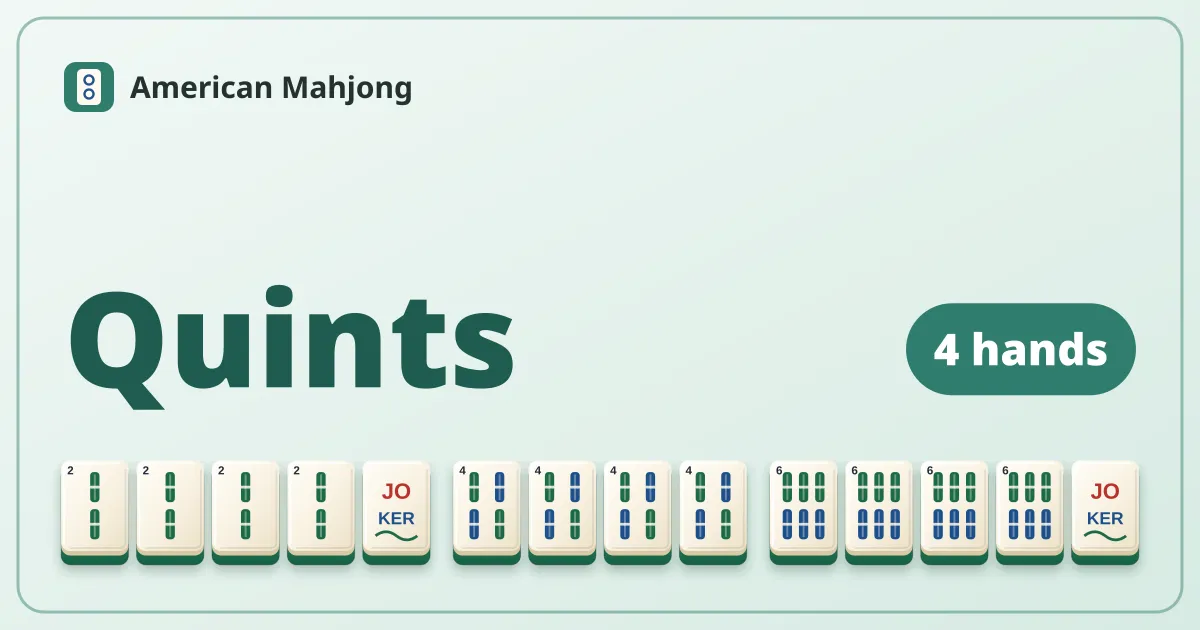 Quints 4 hands
Five of a kind, which only jokers make possible — every hand on our card, joker rules, scoring and odds.
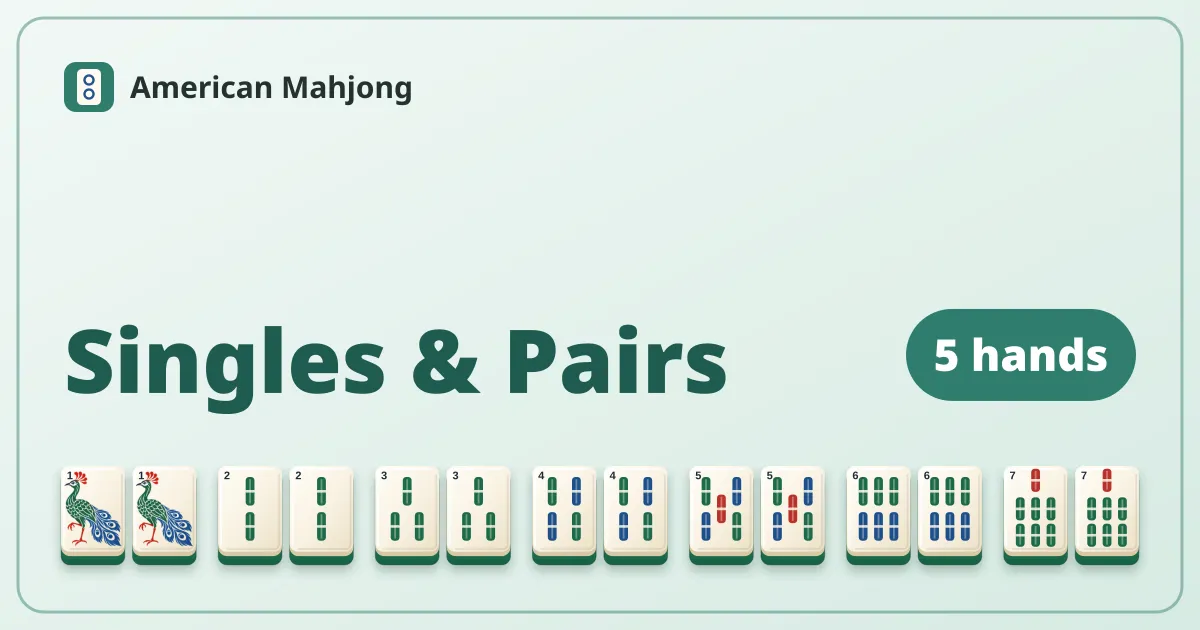 Singles & Pairs 5 hands
Seven pairs, no jokers, always concealed — every hand on our card, why jokers don't work, scoring and odds.
Try it at the table
American Mahjong — Play American Mah Jongg free in your browser against three computer players. The Charleston, jokers, joker exchanges and a full card of hands, with a helper that shows your closest hands. No sign-up.