How to Play American Mahjong: Free Online Mahjong Lessons for Beginners
The whole game from first shuffle to Mah Jongg — tiles, the card, the Charleston, calling, jokers and scoring — explained step by step with pictures.
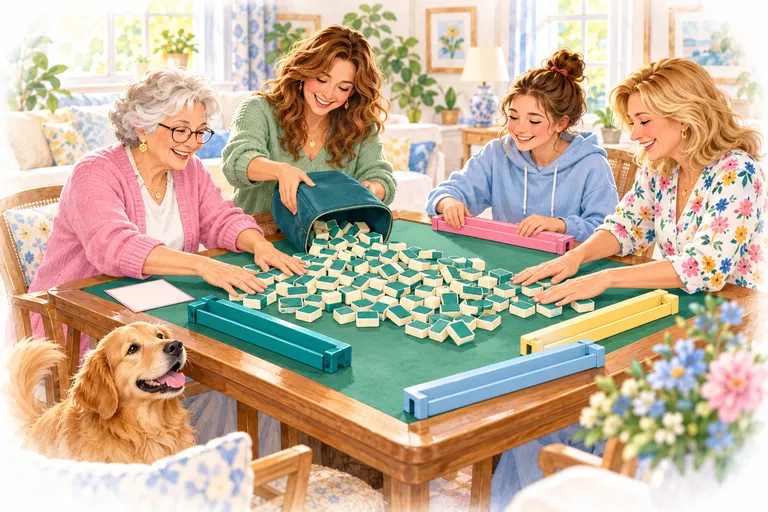
American mahjong is a four-player tile game in which everyone races to turn their tiles into one of the hands printed on a card. This page teaches the whole game, from the first shuffle to calling “Mah Jongg!”, using the same rules as our free American mahjong game. Read it once, then try a game against the computer — the in-game helper does the hard part for you.
On this page
- What American mahjong is and what you need
- The 152 tiles
- Seats, the dealer and the deal
- The Charleston
- A turn: draw and discard
- Calling discards: pungs, kongs and quints
- Jokers and joker swaps
- Winning: Mah Jongg and the card
- Scoring basics
- Special rules: concealed hands, dead hands and wall games
- Beginner strategy tips
- Play American mahjong now
- FAQ
What American mahjong is and what you need
American mahjong (often spelled “Mah Jongg”) grew out of Chinese mahjong in the 1920s and has its own rules. Three things make it different from the Chinese, Hong Kong or Japanese games:
- A card of hands. You can only win with a hand that appears on the card. This site uses its own original card, “House Card 2026”, with 50 hands in 10 categories. See how to read the card.
- Jokers. The set has 8 jokers that stand in for any tile in a group of three or more.
- The Charleston. Before play starts, everyone passes unwanted tiles to each other.
To play at home you need four players, a set of 152 tiles, four racks (long stands that hold your tiles and keep them hidden), and one card for each player. To play online you need nothing at all: our American mahjong online table deals, keeps score and shows your closest hands. You hold 13 tiles; the 14th tile you draw or call has to complete a hand on the card.
The 152 tiles
An American set has 152 tiles. You will see these names on every card and in every lesson. For more pictures, see the tiles.
Three suits, 1 to 9, four of each (108 tiles). Bams (bamboo), Craks (characters) and Dots (circles):
Winds (16) and dragons (12). Four each of East, South, West and North, and four each of the three dragons. Each dragon belongs to a suit: Green goes with Bams, Red with Craks, and the white dragon (“Soap”) with Dots. In year hands the Soap also stands for the zero in 2026.
Flowers (8) and jokers (8). All flowers count as the same tile, written F on the card. Jokers are wild — the most valuable tiles in the game.
Groups have names: a pair is 2 identical tiles, a pung 3, a kong 4 and a quint 5. A quint always needs at least one joker, because there are only four of each tile.
Seats, the dealer and the deal
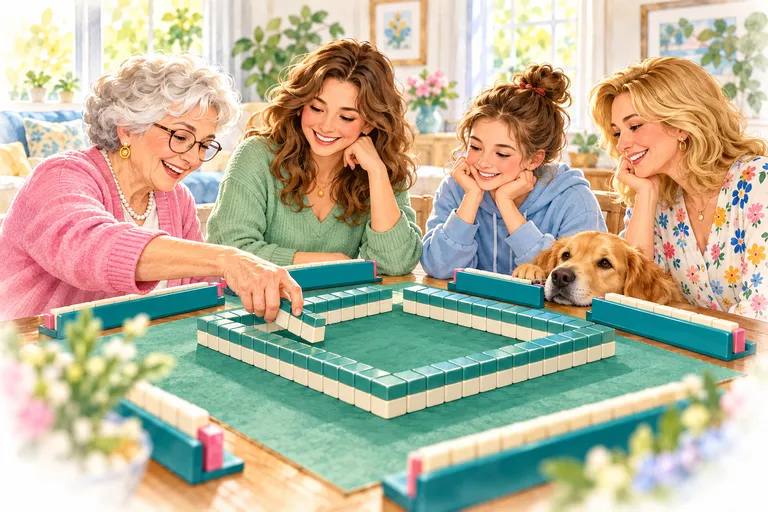
Four players sit around the table. One player is the dealer, called East; the others are South, West and North going around to the right. At a real table everyone turns the tiles face down, shuffles, and builds a wall of 19 stacks two tiles high in front of their rack; dice decide where the dealer breaks the wall.
Then the deal:
- Everyone takes 13 tiles; the dealer takes 14.
- Everyone sets their tiles on their rack, facing themselves, and sorts them.
- After the game, the deal passes to the next player on the right.
In our game the computer shuffles and deals for you, and East moves one seat each game, just like at a real table.
The Charleston
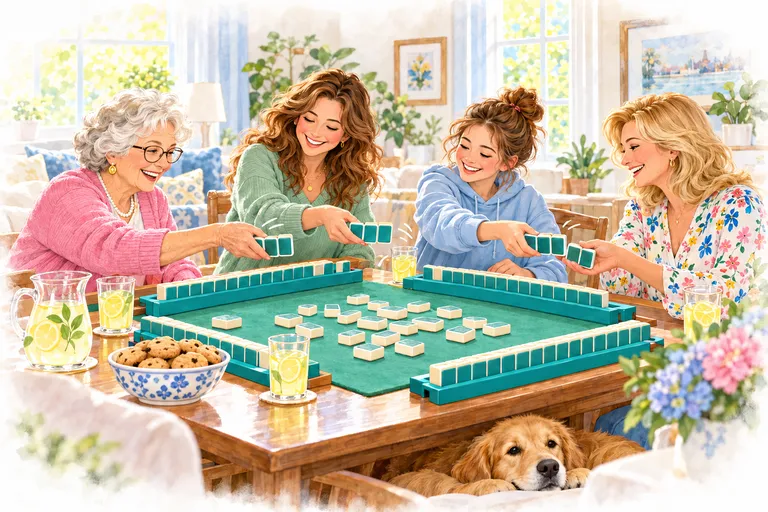
Before anyone draws, players trade tiles they don’t want. Every pass is three tiles, face down, all four players at once. You may pass on tiles you just received.
- First Charleston (always played): pass right, then across, then left.
- Second Charleston (optional): after the first one, anyone may stop it. If even one player says stop, it is skipped. Otherwise, pass left, across, then right — the reverse order.
- Courtesy pass: finally you may swap 0 to 3 tiles with the player across from you. If you want 3 and they want 1, you swap 1 — the smaller number wins.
Jokers can never be passed. At many tables you may also “blind pass” on the last pass of each Charleston (pass on tiles you just received without looking); our game does not use blind passes. Learn what to keep and what to give away in the Charleston guide.
A turn: draw and discard
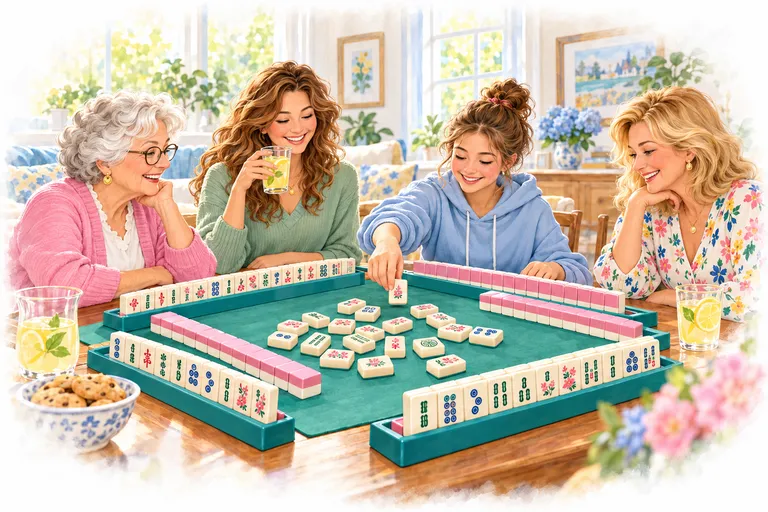
The dealer starts by discarding (the dealer already has 14 tiles). After that, play moves to the right, and each turn has two steps:
- Draw the next tile from the wall.
- Discard one tile face up in the middle of the table and say its name, for example “three crak”.
You always hold 13 tiles between turns. If the tile you draw completes your hand, call “Mah Jongg!” before discarding — that is a self-drawn win. If the wall runs out before anyone wins, it’s a wall game: no one scores and the deal moves on.
Calling discards: pungs, kongs and quints
When another player discards a tile you need, you can call it — but only in two situations:
- To complete a group of three or more (a pung, kong or quint), which you must then expose face up on top of your rack.
- To win with it. This is the only way to call a tile for a single or a pair.
After you call, you discard right away — you don’t draw, and the players between you and the discarder lose their turn. Exposed groups stay on the table and can’t be changed, so only call a tile when your hand really wants it.
If several players want the same tile, Mah Jongg beats an exposure, and between two equal calls the player next in turn after the discarder gets it. A discarded joker is dead: nobody can call it, not even to win.
Jokers and joker swaps
Jokers fill in for any tile in a pung, kong or quint. They can never be used in a single or a pair, so pairs like FF and singles like the NEWS winds or the year 2026 need real tiles.
The favorite move in American mahjong is the joker swap. On your turn, if any player’s exposure has a joker in it and you hold the real tile it stands for, you may trade your tile for that joker:
You can swap after you draw (or after you call), before you discard, and you can make several swaps in one turn. See all the joker rules.
Winning: Mah Jongg and the card
You win by making 14 tiles that match one line on the card exactly. Each line shows the groups, and colors show the suits: the same color means the same suit, different colors mean different suits. The X or C at the end says whether you may expose groups, and the number is the hand’s value. Here is one line from our card and a finished hand:
| Card value | 25 |
|---|---|
| No jokers (doubles the value) | Uses jokers — no bonus |
| Won on a discard: discarder pays double | 50 + 25 + 25 = 100 |
| Self-drawn: everyone pays double | 50 × 3 = 150 |
The card is grouped into categories such as 2468, Like Numbers, Consecutive Run, Winds & Dragons, Quints and Singles & Pairs. Browse every line on the full card. Before you call Mah Jongg, check that every group, suit and dragon matches the line.
Scoring basics
Every hand’s value is printed on the card. On our card the values run from 25 to 50 points; harder hands are worth more.
- Won on a discard: the player who threw the winning tile pays double the value; the other two pay the value.
- Self-drawn: all three players pay double.
- Jokerless: a hand with no jokers at all doubles again (Singles & Pairs hands can’t use jokers, so they don’t get this bonus).
- The dealer doesn’t pay or collect extra, and a wall game scores nothing.
The same 2468 hand, this time with no jokers — the numbers below come straight from the game’s scoring code:
| Card value | 25 |
|---|---|
| No jokers (doubles the value) | ×2 = 50 |
| Won on a discard: discarder pays double | 100 + 50 + 50 = 200 |
| Self-drawn: everyone pays double | 100 × 3 = 300 |
That is why feeding a winning tile hurts: the discarder pays twice as much as the others. More examples in Mah Jongg and scoring.
Special rules: concealed hands, dead hands and wall games
- Concealed hands (C). A hand marked
Cmust be built entirely in your rack. You can’t call tiles to expose groups — the only discard you may call is the one that completes the hand. Concealed hands, such as the Singles & Pairs hands, are worth more. - Dead hands. At a home table, a player whose exposures no longer fit any hand on the card, or who calls Mah Jongg by mistake, is usually declared “dead”: they stop playing but still pay the winner. Our game never lets you make an exposure that fits no hand, and the Mah Jongg button only appears for a real winning hand, so you can’t go dead by accident. Instead, the helper drops any hand you can no longer make because the tiles it needs are gone, and marks it “Dead” if you pinned it.
- Wall games. If the last tile is drawn and discarded without a winner, nobody pays and the next player deals.
- House rules. Tables vary. Our game does not use blind passes, dead-hand penalties, or the rule that a player who feeds a third exposure pays for everyone.
Beginner strategy tips

- Pick two or three target hands, not one. Use the Charleston to see which of them your tiles grow into, then commit after the second Charleston.
- Pass what none of your targets can use. If all your targets are evens, odd numbers go first.
- Keep pairs and pungs. Two or three of the same tile are a head start for most hands.
- Never throw a joker. A discarded joker is dead and helps no one — least of all you.
- Don’t call too early. Every exposure tells the table what you’re building and locks you in.
- Read the discards. If three of the tiles you need are gone, change hands before it’s too late.
- Watch for joker swaps. Check every exposure with a joker in it on each of your turns.
- Play safe late in the game. When someone has three exposures, discard tiles that their hand can’t use.
There’s much more in the strategy guide.
Play American mahjong now
You know the rules — now play a few hands. Our free American mahjong game runs in your browser with no sign-up and no download. You play against three computer opponents, and the card panel shows your closest hands, counts the tiles you still need and warns you when a hand is dead. Start on Easy and try the daily deal once you’re comfortable.
FAQ
How many tiles are in an American mahjong set?
152: three suits of 1–9 (four of each, 108 tiles), 16 winds, 12 dragons, 8 flowers and 8 jokers. Racks and dice are usually included too.
What is the Charleston?
A tile exchange before play starts. Everyone passes three tiles right, across and left; a second Charleston (left, across, right) follows unless anyone stops it; and you finish with an optional courtesy pass of up to three tiles with the player across. Jokers can’t be passed.
Can I use a joker in a pair?
No. Jokers only go in groups of three or more — pungs, kongs and quints. Singles and pairs must be real tiles, and Singles & Pairs hands can’t use jokers at all.
Can I pick up a discard for a pair?
Only if that tile wins the game. Otherwise you can call a discard only to complete a pung, kong or quint, which you then expose.
How is American mahjong scored?
Each hand on the card has a value. If you win on a discard, the discarder pays double and the other two pay the value; if you draw the winning tile yourself, everyone pays double. A hand without jokers is worth double again.
Do I need the official card to play here?
No. This site uses its own original card, “House Card 2026”, with the same kinds of categories, and it is built into the game. It is not the card published by the National Mah Jongg League, and this site is not affiliated with them; to play their rules with friends, buy the current card from them.
Is it hard to learn?
Most players can play a full game after one lesson. The card looks busy at first, but the in-game helper shows which hands you’re closest to, so you can learn while you play.
Try it at the table
American Mahjong — Play American Mah Jongg free in your browser against three computer players. The Charleston, jokers, joker exchanges and a full card of hands, with a helper that shows your closest hands. No sign-up.