How a game goes
The Charleston
The tile-passing ritual before play. The first Charleston is required, anyone can stop the second, and you finish with an optional courtesy pass of up to 3 tiles across.
On this page
Why pass tiles?
After the deal, most hands are a mess. The Charleston lets everyone pass away tiles they can’t use and pick up tiles that might help. It is unique to American mahjong, and play only begins once it’s over.
Each pass is all 4 players passing 3 tiles at the same time. Nobody sees what you pass, and the tiles you get back are ones someone else didn’t want.
The order of passes
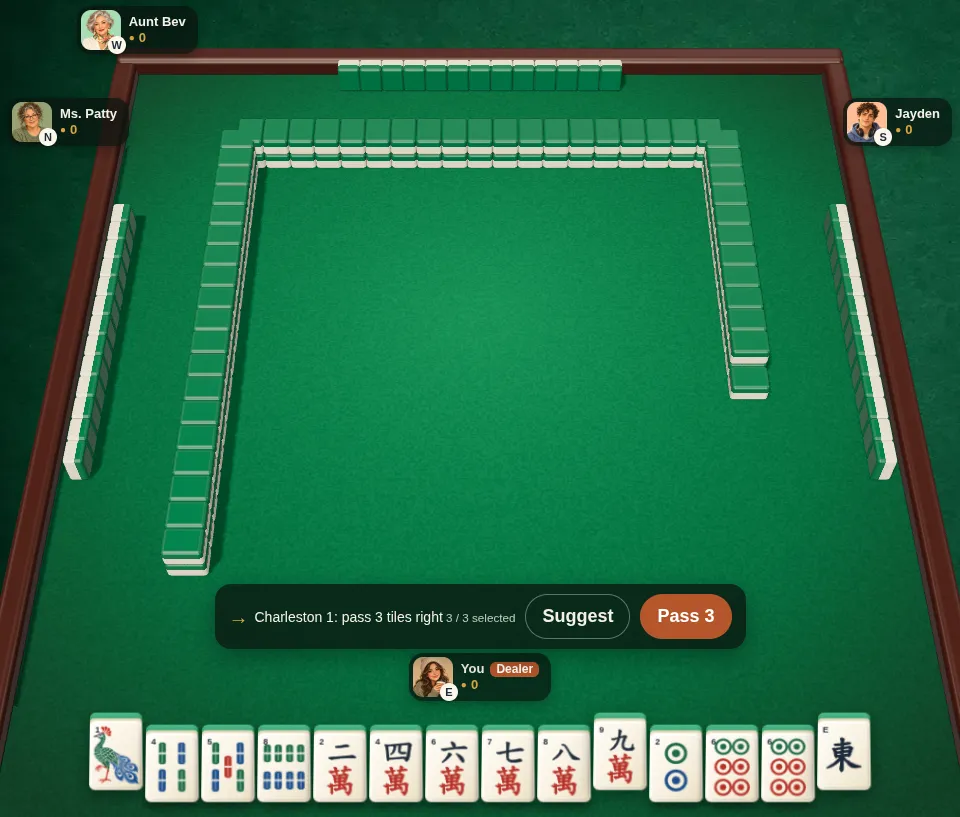
First Charleston (required)
- Pass 3 tiles right
- Pass 3 tiles across
- Pass 3 tiles left
Second Charleston (can be stopped)
When the first Charleston ends, the game asks “Do a second Charleston?”. If any one player presses “Stop”, the whole second Charleston is cancelled. If everyone continues, the order is reversed:
- Pass 3 tiles left
- Pass 3 tiles across
- Pass 3 tiles right
Courtesy pass
Finally, you can swap 0 to 3 more tiles with the player across from you. Each of you chooses how many to swap, and the smaller number wins: if you want to swap 3 and your opposite only wants 1, you swap just 1. If you don’t want to swap at all, press “No courtesy pass”.
Charleston rules
- Jokers can’t be passed. You can’t select them during the Charleston.
- Every pass (except the courtesy pass) must be exactly 3 tiles; the “Pass 3” button only lights up once you’ve picked 3.
- Tiles you received in one pass can be passed on in the next.
Choosing what to pass
- Check the card panel first. It lists the hands you’re closest to. Pick two or three that go in different directions as candidates.
- Pass tiles none of your candidates can use. If they’re all 2468 hands, for example, get rid of your odd numbers first.
- Hold on to pairs and sets. Two or three of the same tile usually make a good starting point.
- Don’t commit too early. Your hand can change a lot over the first Charleston, so stay flexible until the second one ends.
- Think twice before passing flowers and winds. Lots of hands use flowers, and winds are valuable in Winds & Dragons.
If you’re not sure what to pass, press “Suggest” and the game will pick 3 tiles for you. Pass them as they are, or change them first.
When should you stop?
If after the first Charleston your hand is already close to a hand on the card (the card panel shows it 4–5 tiles away or less), press “Stop” so your good tiles don’t get passed away. If your hand is still a mess, keep going.
Remember that other players can stop it too, so the second Charleston doesn’t always happen.
Up nextDrawing, discarding and calling →