The basics
Your first game
The goal of American mahjong, how a game flows and what each part of the table does. Read this page and you are ready to play.
On this page
What is the goal?
Four players each hold a hand of tiles and race to turn 14 tiles into one of the hands printed on the card. The first to do it calls “Mah Jongg!” and collects from the other three.
The big difference from Chinese or Hong Kong mahjong: the winning hands are fixed, and they are all printed on a single card. This site uses its own original card, “House Card 2026”, with 50 hands in 10 categories. No need to memorize it — the card sits right next to the table while you play.
The four stages of a game
- The deal: everyone gets 13 tiles; the dealer (East) gets 14.
- The Charleston: before play starts, everyone passes tiles to each other to get rid of what they don’t need. See The Charleston.
- Draw, discard and call: starting with the dealer, each player draws a tile and discards a tile. If someone discards a tile you need, you can call it. See Drawing, discarding and calling.
- Mah Jongg or a wall game: the game ends when someone completes a hand. If the wall runs out first, it’s a wall game and nobody scores.
Start your first game
Press “Play now” on the home page to jump straight into a game, or go to the lobby, choose a computer level and press “Start a game”. For your first game, choose Easy: easy bots rarely call your discards, so you have more time to study the card and think things through.
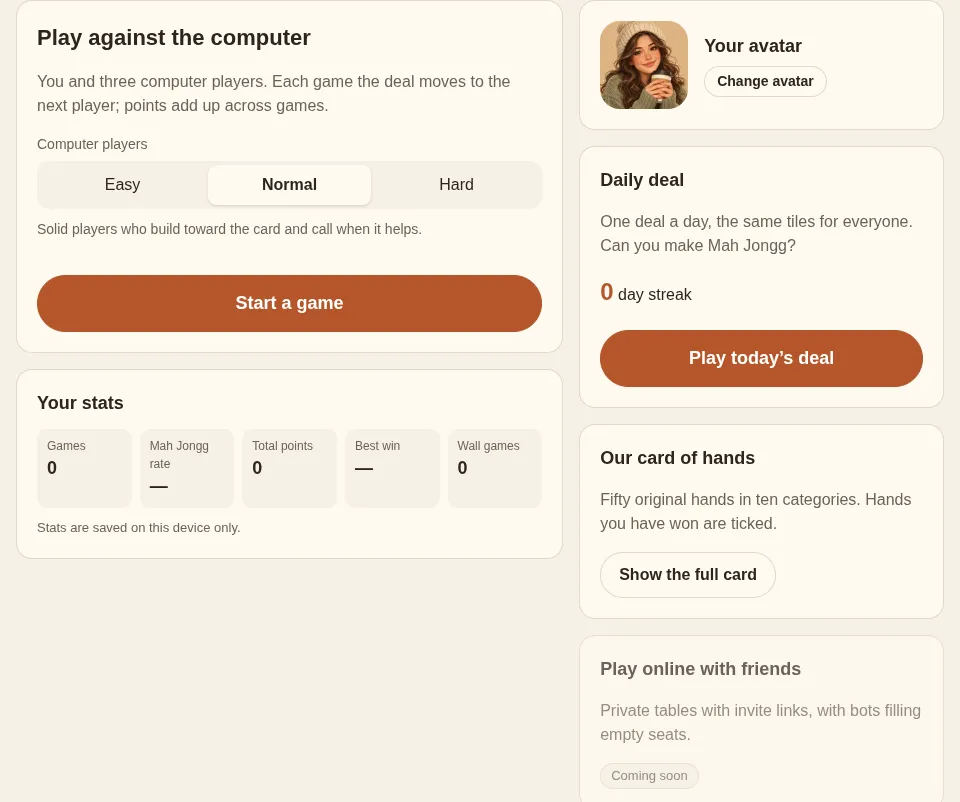
The lobby has two more entry points:
- Daily deal: one deal a day, and everyone in the world gets the same tiles. A great way to keep your skills sharp.
- Continue your game: games are saved automatically on this device, so you can close the tab and pick up where you left off.
Reading the table
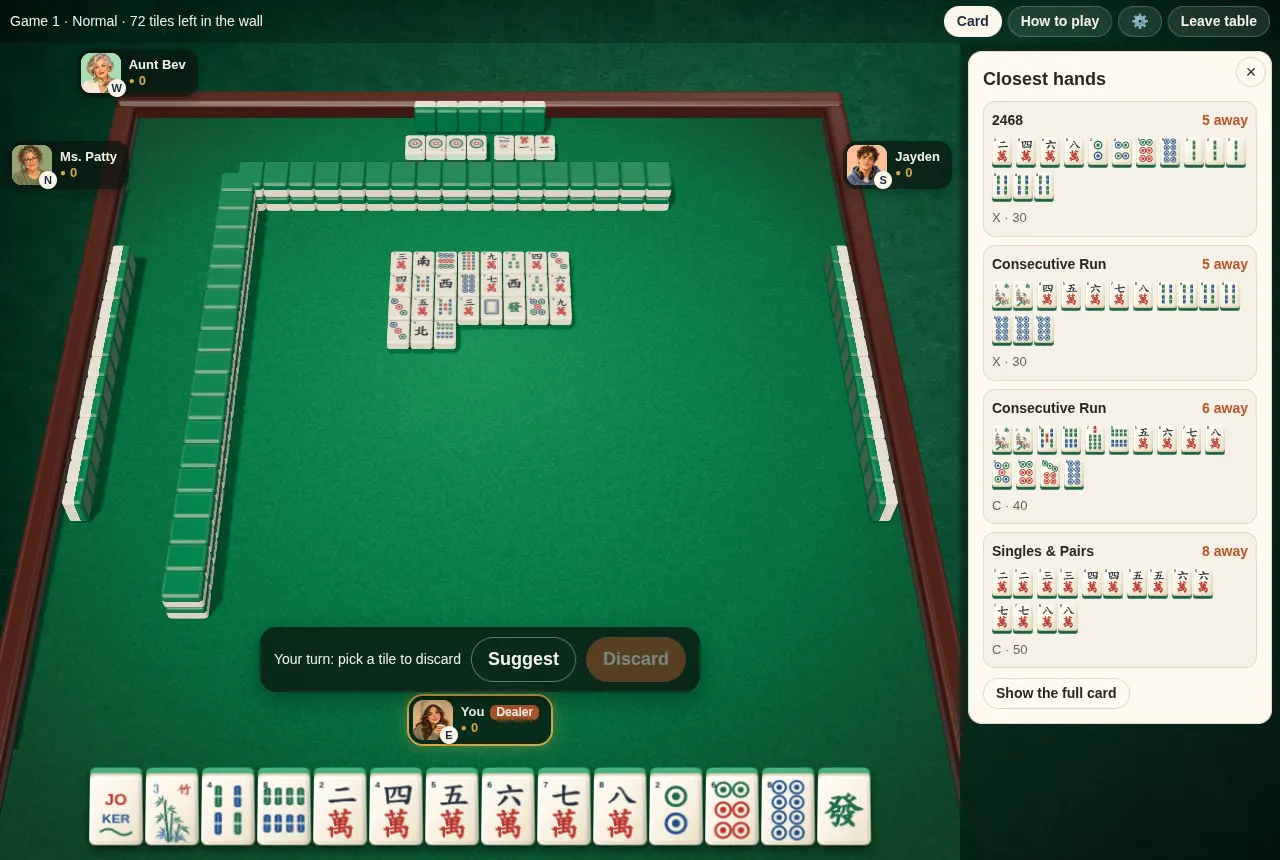
- Your tiles are at the bottom, standing in front of you. They are sorted automatically: jokers first, then flowers, bams, craks, dots, winds and dragons.
- The three bots sit at the top, left and right. Their tiles stand in front of them, and any groups they expose lie on the table. Each name plate shows an avatar, seat wind (E, S, W, N) and score, and the dealer’s plate is marked “Dealer”.
- The discards are in the middle. Every tile thrown goes here, and the latest one is outlined in gold.
- The bar along the top shows the game number, the bot difficulty and how many tiles are left in the wall. On its right are the “Card” toggle, “How to play”, “Settings” and “Leave table”.
- The card panel is on the right (press “Card” to open or close it). It lists the hands you are closest to and how many tiles each one still needs. See Helper and settings.
On a phone, turn it sideways: in portrait the game pauses, and it carries on as soon as you rotate. In the lobby, tap your avatar to pick a character you like or upload your own photo (it is stored only on this device).
What do I do on my turn?
When your turn comes, the game has already drawn a tile for you. All you have to do is pick a tile to discard: tap it to select it, then press “Discard” (or tap the same tile again).
If your tiles already form a hand, a “Mah Jongg!” button appears — press it and you win. When someone else discards, call buttons only pop up if you can actually use that tile. Otherwise the game moves on by itself, so you don’t have to keep pressing “Pass”.
Tips for your first game
- Don’t rush the Charleston. Press “Suggest” to see which tiles the game would pass, and compare with the card to work out why.
- Keep an eye on the top two or three hands in the card panel, and discard tiles none of them can use first.
- Don’t worry about mistakes: a game takes about ten minutes, and after a few you’ll get the hang of it.