American Mahjong · 4 hands
Quints Hands in American Mahjong: Jokers, Scoring and Odds
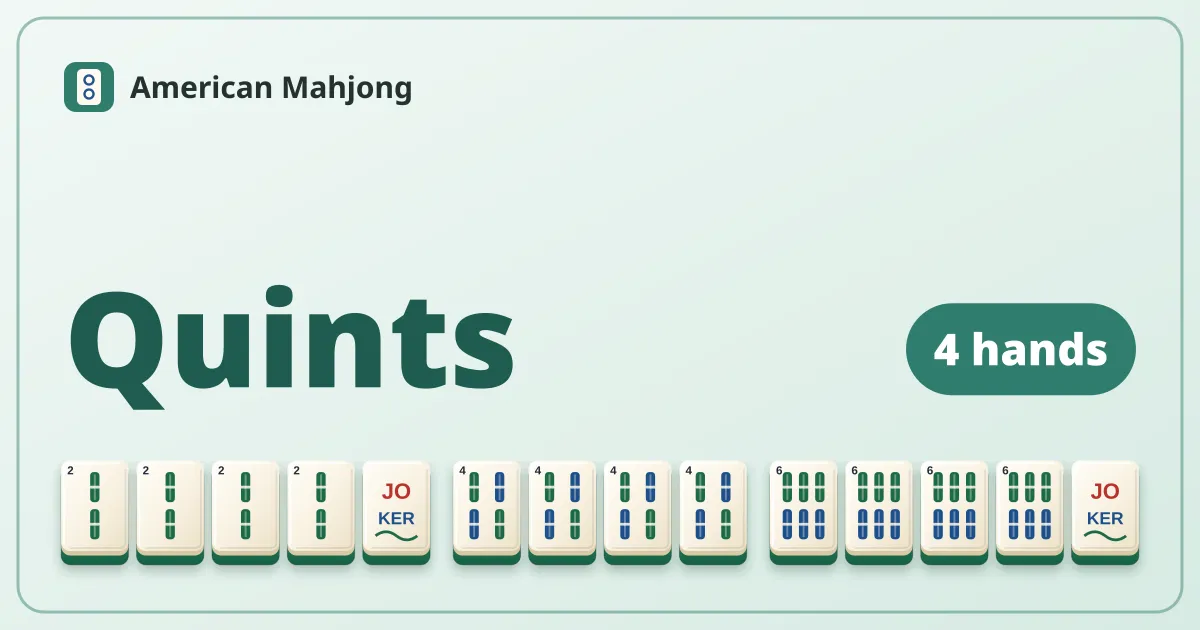
In American mahjong, a quint is five identical tiles. A set has only four of each tile, so a quint is impossible without at least one joker — and every Quints line on our House Card has two quints. These are the most joker-hungry hands on the card and pay accordingly: 40 to 45 points.
| Card value | 40 |
|---|---|
| No jokers (doubles the value) | Uses jokers — no bonus |
| Won on a discard: discarder pays double | 80 + 40 + 40 = 160 |
| Self-drawn: everyone pays double | 80 × 3 = 240 |
On this page
What counts as a Quints hand
- At least one group of five identical tiles; every line on our card has two quints and fills the rest with kongs
- Each quint needs at least one joker, because no tile has a fifth copy — our quints are suit tiles, North winds or dragons, never flowers
- Two lines use any like number and one uses any three consecutive numbers, marked on the card (see reading the card)
- All four lines are
X: you may call a discard to expose a pung, kong or quint
Every Quints hand on our card
- North quint and one number in two suits — five Norths, a kong of your number and a quint of the same number in another suit.
- 2, 4, 6 in one suit — two quints around a kong of 4s.
- Flowers, a number quint and a dragon quint — four flowers, five of any number, and five dragons of a different suit.
- Three consecutive numbers in three suits — quint, kong, quint, one suit each.
How jokers work in Quints hands
The joker rules on this site are the same for every category: a joker can stand in for any tile in a group of three or more, never in a single or a pair. Quints simply push that rule to its limit:
- Two jokers minimum. Two quints, one joker each. More jokers make it easier: a quint can be three real tiles and two jokers, and so on.
- The no-joker double is out of reach. The game would double a jokerless hand in any category except Singles & Pairs, but a quint can't be built without jokers, so no Quints hand ever earns the double.
- Calling helps. You can call a discard for a quint when you hold four matching tiles or jokers; the game puts your real tiles in first and adds jokers only as needed.
- Exposed jokers can be taken. Once a quint with a joker is on the table, any player holding the real tile can swap it for your joker on their turn (see jokers).
| Card value | 40 |
|---|---|
| No jokers (doubles the value) | Uses jokers — no bonus |
| Won on a discard: discarder pays double | 80 + 40 + 40 = 160 |
| Self-drawn: everyone pays double | 80 × 3 = 240 |
| Card value | 45 |
|---|---|
| No jokers (doubles the value) | Uses jokers — no bonus |
| Won on a discard: discarder pays double | 90 + 45 + 45 = 180 |
| Self-drawn: everyone pays double | 90 × 3 = 270 |
How Quints hands are scored
Each hand pays its card value. On a discard, the player who discarded pays twice the value and the other two pay once; on a self-drawn win, all three pay twice. The tables are worked out by the game's own scoring code.
| Card value | 45 |
|---|---|
| No jokers (doubles the value) | Uses jokers — no bonus |
| Won on a discard: discarder pays double | 90 + 45 + 45 = 180 |
| Self-drawn: everyone pays double | 90 × 3 = 270 |
Quints odds
How close your deal is
Even with jokers counted, a deal starts far from a Quints hand: before the Charleston, a 13-tile deal is within 7 tiles of the nearest one 2.5% of the time; after the Charleston, that rises to 11%. Each joker you hold counts as one tile closer.
| Quints | At the deal | After the Charleston |
|---|---|---|
| 5 or fewer away | 0.02% | 0.43% |
| 6 or fewer away | 0.27% | 2.4% |
| 7 or fewer away | 2.5% | 11% |
| 8 or fewer away | 13% | 31% |
| 9 or fewer away | 43% | 63% |
Source: 20,000 random 13-tile deals (jokers and flowers included), before the Charleston.
Source: 1,500 games of computer-vs-computer play on this site (normal level, Charleston included). Each computer has its own slight taste for categories.
How often Quints wins
When the computers play normally, Quints hands were only 0.57% of all wins, collecting 210 points on average; 38% were self-drawn and, as explained above, 0% used no jokers. With so few wins, the average and the self-drawn share are very rough.
| Category | Share of wins |
|---|---|
| Like Numbers | 40% |
| Consecutive Run | 31% |
| Winds & Dragons | 9.5% |
| 2468 | 6.5% |
| 369 | 4.0% |
| 2026 | 3.4% |
| 13579 | 3.1% |
| Addition | 0.72% |
| Quints | 0.57% |
| Singles & Pairs | 0.57% |
Source: 1,500 games of computer-vs-computer play on this site (normal level, Charleston included). Each computer has its own slight taste for categories.
Is it worth forcing Quints?
We had the player whose deal was closest to Quints play nothing but Quints hands — Charleston, discards, calls and wins — while the other three played normally, and compared the result with the same kind of deal played normally.
| At the deal | Hands | Made it | Someone else won | Wall game | Avg. result forcing it | Avg. result playing normally |
|---|---|---|---|---|---|---|
| 6 or fewer away | 22 | 4.5% | 82% | 14% | −36 | +60 |
| 7 | 187 | 11% | 72% | 17% | −11 | +26 |
| 8 | 532 | 6.2% | 77% | 17% | −26 | +22 |
| 9+ away | 759 | 1.8% | 78% | 20% | −36 | −4 |
Source: 1,500 games of computer play on this site. In each, the player whose deal was closest to Quints played only Quints hands; the other three played normally. Money is the card value as paid in the game.
Along with Singles & Pairs, this was one of the clearest results on the card: forcing Quints lost heavily in every group.
- From a deal within 7 tiles, forcing Quints worked only 11% of the time, for an average of −14; the same kind of deal played normally averaged +31.
- From within 8 tiles, it worked 7.4% of the time (−23 against +24); someone else won first 76% of the time and 17% ended in a wall game.
- Why the gap is so big: a deal that starts close to Quints is mostly a deal rich in jokers — and jokers make every category easier. Played normally, those jokers go into whichever hand the tiles support. Forcing Quints spends them on two five-tile groups and waits for kongs that rarely come.
- Deals within 6 tiles were too rare (a couple of dozen) for the first row to mean anything.
Tips for Quints hands
- Count jokers before anything else. With fewer than two jokers, a Quints hand depends on drawing more of the eight in the set.
- Kongs first. Each quint grows out of a kong: four real tiles plus one joker. A deal with two kongs or near-kongs is the only real start.
- Don't let your jokers sit exposed for long. An exposed quint with two jokers invites swaps; expose late if you can.
- Like-number quints have more chances. Two of the four lines let you pick the number, so they fit more deals.
When to switch: if the kongs are there but the jokers aren't, the same tiles often fit Like Numbers or a Consecutive Run with only kongs. Try a few hands of free American mahjong online and watch how many jokers a Quints hand actually needs — the helper shows your closest hands as you go.
FAQ
What is a quint in mahjong?
A quint is a group of five identical tiles. In American mahjong it can only be made with jokers, because each tile has just four copies.
How many jokers do you need for a Quints hand?
At least one per quint. Every Quints line on our House Card has two quints, so you need at least two jokers.
Can a Quints hand be jokerless?
No. Without jokers a quint is impossible, so Quints hands never get the no-joker double.
How many points is a Quints hand worth?
On our House Card, Quints hands are worth 40 to 45 points — among the highest on the card.
Is this the official NMJL card?
No. The National Mah Jongg League publishes a new copyrighted card every year. This site uses its own original card with the same kinds of categories, so the exact lines differ.
Related categories
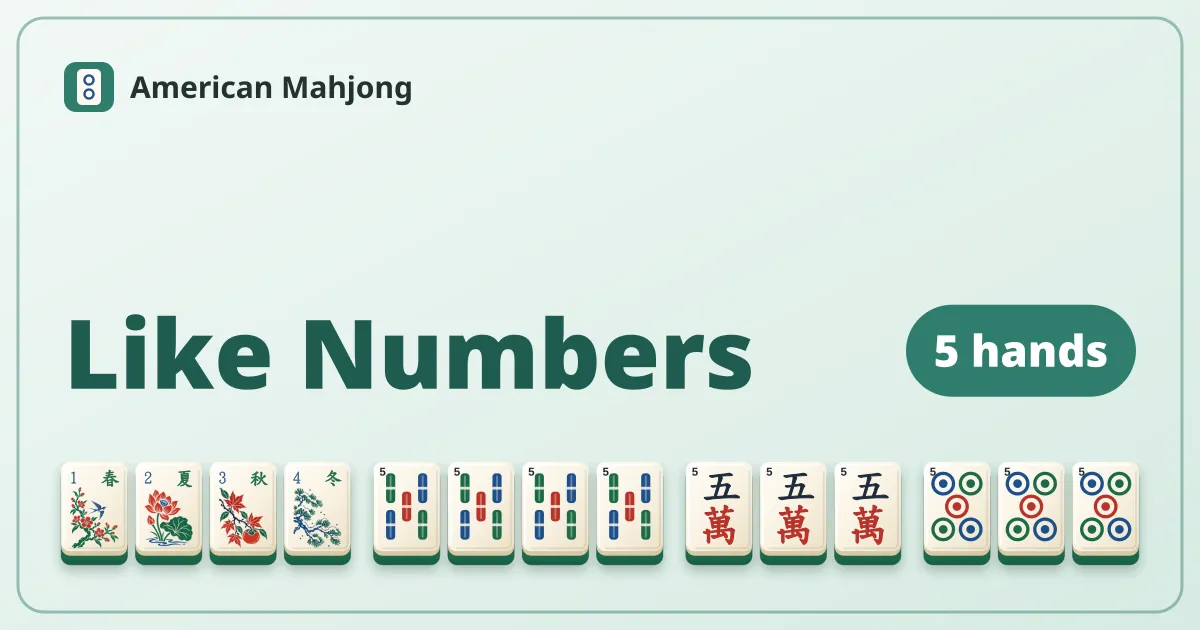 Like Numbers 5 hands
One number, any number, across all three suits — every hand on our card, joker rules, scoring and odds.
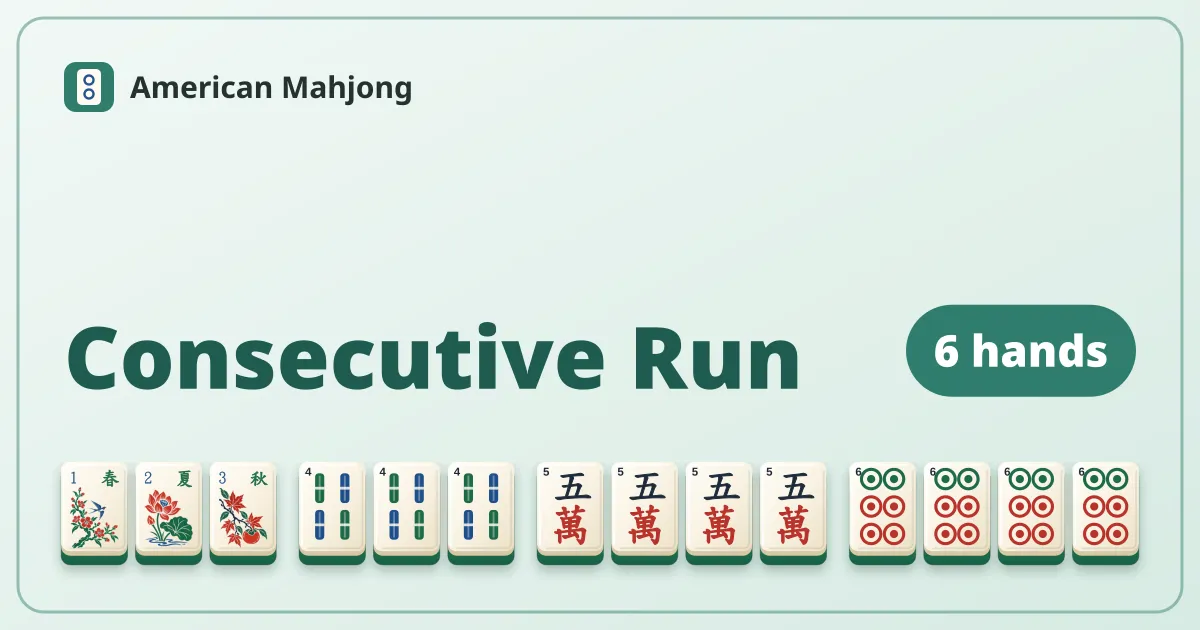 Consecutive Run 6 hands
Numbers in a row, starting wherever your tiles are — every hand on our card, joker rules, scoring and odds.
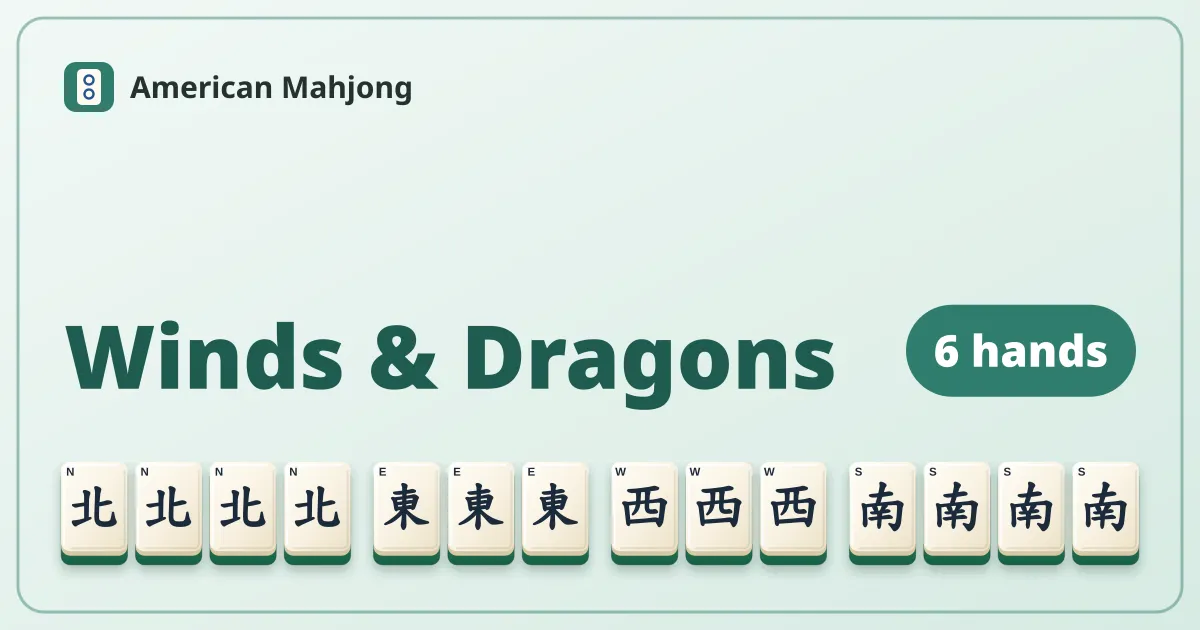 Winds & Dragons 6 hands
Hands built mostly from winds and dragons — every hand on our card, joker rules, scoring and odds.
Try it at the table
American Mahjong — Play American Mah Jongg free in your browser against three computer players. The Charleston, jokers, joker exchanges and a full card of hands, with a helper that shows your closest hands. No sign-up.