American Mahjong · 4 hands
Addition Hands in American Mahjong: How They Work, Scoring and Odds
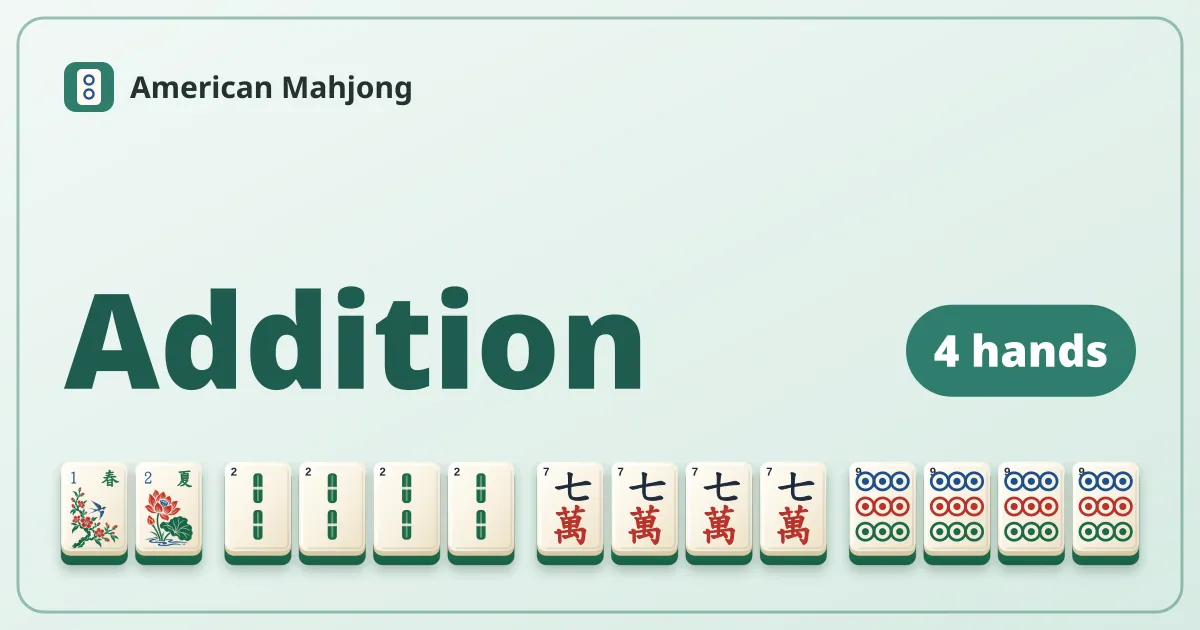
In American mahjong, an Addition hand (sometimes called an addition or math hand) reads like a sum: the first two numbers add up to the third. Our House Card has four of them — 2 + 7 = 9, 1 + 6 = 7, 3 + 3 = 6 and 5 + 0 = 5 — worth 25 to 30 points.
| Card value | 25 |
|---|---|
| No jokers (doubles the value) | ×2 = 50 |
| Won on a discard: discarder pays double | 100 + 50 + 50 = 200 |
| Self-drawn: everyone pays double | 100 × 3 = 300 |
On this page
What counts as an Addition hand
- The numbers are fixed: each line prints its own sum, and you can't swap in another one
- The sum is built from kongs and pungs, so every number group can take jokers
- A
0is the white dragon (Soap), as in the year hands - Colors decide the suits (see reading the card); all four lines are
X, so you may call discards - Jokers can fill any group of three or more, never a single or a pair
Every Addition hand on our card
- 2 + 7 = 9 — flowers and three kongs, one suit each.
- 1 + 6 = 7 — two pungs and a kong in one suit, plus a dragon kong of another suit.
- 3 + 3 = 6 — kongs of 3s in two suits and a kong of 6s in the third.
- 5 + 0 = 5 — kongs of 5s in two suits with four Soaps as the zero between them.
How jokers work in Addition hands
Apart from the flower pairs, every group is a pung or a kong, so jokers help in every line.
| Card value | 25 |
|---|---|
| No jokers (doubles the value) | Uses jokers — no bonus |
| Won on a discard: discarder pays double | 50 + 25 + 25 = 100 |
| Self-drawn: everyone pays double | 50 × 3 = 150 |
| Card value | 30 |
|---|---|
| No jokers (doubles the value) | Uses jokers — no bonus |
| Won on a discard: discarder pays double | 60 + 30 + 30 = 120 |
| Self-drawn: everyone pays double | 60 × 3 = 180 |
How Addition hands are scored
Each hand pays its card value, and a hand built with no jokers at all is worth double. On a discard, the player who discarded pays twice the value and the other two pay once; on a self-drawn win, all three pay twice. The tables are worked out by the game's own scoring code.
| Card value | 30 |
|---|---|
| No jokers (doubles the value) | ×2 = 60 |
| Won on a discard: discarder pays double | 120 + 60 + 60 = 240 |
| Self-drawn: everyone pays double | 120 × 3 = 360 |
Addition odds
How close your deal is
Every Addition line needs three or four pungs and kongs of fixed tiles, so deals almost never start close. Before the Charleston, a 13-tile deal is within 7 tiles of the nearest Addition hand 2.1% of the time; after the Charleston, that rises to 5.4%.
| Addition | At the deal | After the Charleston |
|---|---|---|
| 5 or fewer away | 0.02% | 0.22% |
| 6 or fewer away | 0.18% | 1.0% |
| 7 or fewer away | 2.1% | 5.4% |
| 8 or fewer away | 11% | 18% |
| 9 or fewer away | 37% | 44% |
Source: 20,000 random 13-tile deals (jokers and flowers included), before the Charleston.
Source: 1,500 games of computer-vs-computer play on this site (normal level, Charleston included). Each computer has its own slight taste for categories.
How often Addition wins
When the computers play normally, Addition hands were only 0.72% of all wins, collecting 150 points on average. 50% of those wins were self-drawn and 10% used no jokers. Those few wins are too few for the last three numbers to mean much.
| Category | Share of wins |
|---|---|
| Like Numbers | 40% |
| Consecutive Run | 31% |
| Winds & Dragons | 9.5% |
| 2468 | 6.5% |
| 369 | 4.0% |
| 2026 | 3.4% |
| 13579 | 3.1% |
| Addition | 0.72% |
| Quints | 0.57% |
| Singles & Pairs | 0.57% |
Source: 1,500 games of computer-vs-computer play on this site (normal level, Charleston included). Each computer has its own slight taste for categories.
Is it worth forcing Addition?
We had the player whose deal was closest to Addition play nothing but Addition hands — Charleston, discards, calls and wins — while the other three played normally, and compared the result with the same kind of deal played normally.
| At the deal | Hands | Made it | Someone else won | Wall game | Avg. result forcing it | Avg. result playing normally |
|---|---|---|---|---|---|---|
| 6 or fewer away | 23 | 30% | 65% | 4.3% | +3 | +15 |
| 7 | 127 | 14% | 75% | 11% | −18 | +31 |
| 8 | 491 | 10% | 78% | 12% | −27 | +17 |
| 9+ away | 859 | 5.1% | 83% | 12% | −34 | −3 |
Source: 1,500 games of computer play on this site. In each, the player whose deal was closest to Addition played only Addition hands; the other three played normally. Money is the card value as paid in the game.
Forcing Addition does produce Addition wins — far more often than normal play, where the computers almost never go for it — but it still cost money in every group.
- From a deal within 7 tiles, forcing Addition worked 17% of the time for an average of −15; the same kind of deal played normally averaged +29.
- From within 8 tiles, it worked 12% of the time (−24 against +19), and someone else won first 77% of the time.
- Deals within 6 tiles of an Addition hand were so rare — a couple of dozen in 1,500 games — that the first row of the table means very little.
Tips for Addition hands
- Look for kongs, not runs. You need three or four of the same tile for each number; a scattering of the right numbers is not enough.
- Jokers are the engine. With three or four big groups to fill, most finished Addition hands use jokers.
- 5 + 0 = 5 needs Soaps. Hold on to Soaps when you have 5s in two suits.
- 3 + 3 = 6 is a hidden Like Numbers hand. Two kongs of 3s are already halfway to a Like Numbers line, so keep both options open.
When to switch: if your kongs share one number, Like Numbers is more flexible; if you hold Soaps with 2s and 6s, try 2026. Play a few hands of free American mahjong online to see how rarely Addition comes together — the helper shows your closest hands as you go.
FAQ
What is an Addition hand in mahjong?
An Addition hand is a line on the American mahjong card that spells out a sum, such as 2 + 7 = 9, with kongs and pungs of those numbers.
Can I choose my own sum?
No. Each line prints its own numbers. On our House Card the sums are 2 + 7 = 9, 1 + 6 = 7, 3 + 3 = 6 and 5 + 0 = 5.
Can you use jokers in an Addition hand?
Yes, in any group of three or more identical tiles — which is every number group in these lines. Only the pairs of flowers must be real tiles.
How many points is an Addition hand worth?
On our House Card, Addition hands are worth 25 to 30 points, doubled if you use no jokers.
Is this the official NMJL card?
No. The National Mah Jongg League publishes a new copyrighted card every year. This site uses its own original card with the same kinds of categories, so the exact lines differ.
Related categories
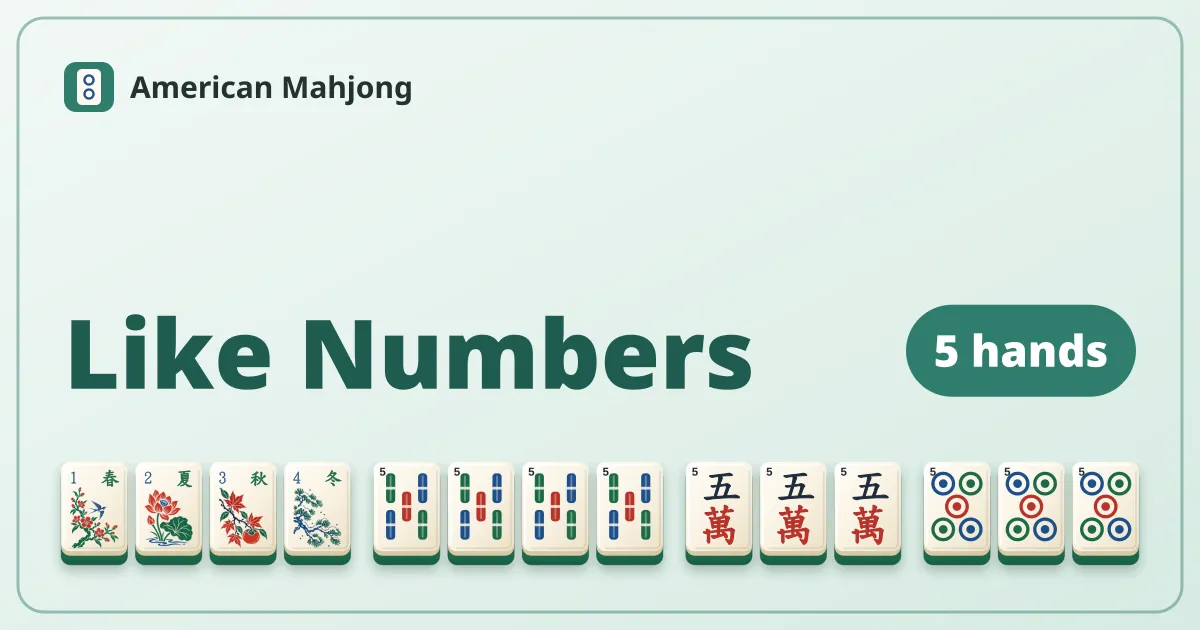 Like Numbers 5 hands
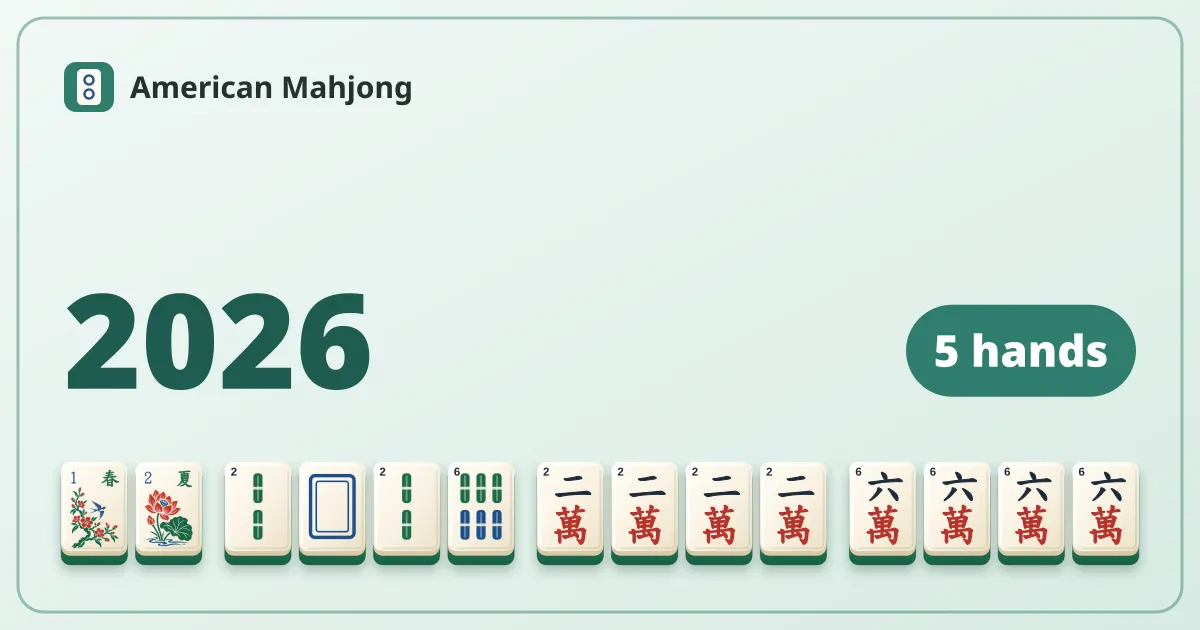 2026 5 hands
Try it at the table
American Mahjong — Play American Mah Jongg free in your browser against three computer players. The Charleston, jokers, joker exchanges and a full card of hands, with a helper that shows your closest hands. No sign-up.